1 USD to PKR in 1947 Discover Pakistan’s First Ever Dollar Rate
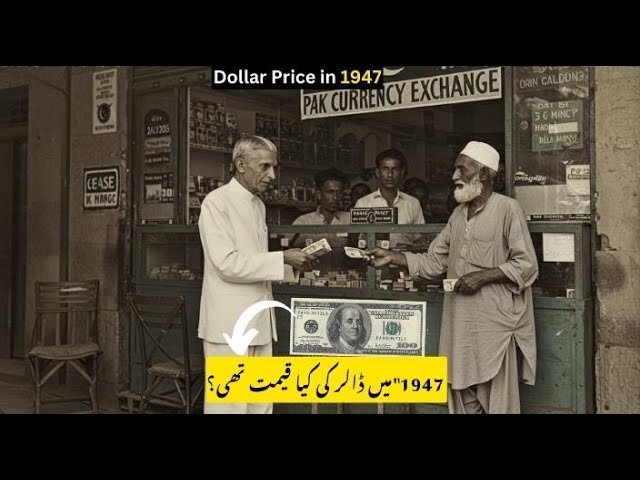
The exchange rate of 1 USD to PKR in 1947 is a topic that attracts significant historical and economic interest. The year 1947 marked the creation of Pakistan as an independent state following the partition of British India. At that time, Pakistan inherited much of its economic and financial structure from British India, including its currency system. Understanding the value of 1 US dollar in Pakistani rupees in 1947 requires examining the broader historical, political, and economic context of that era.

In 1947, the exchange rate of 1 USD was approximately 3.31 Pakistani Rupees (PKR). This rate was not determined by open market forces as it is today. Instead, it was linked to the British Pound Sterling under a fixed exchange rate system. To fully understand this rate, it is important to explore how Pakistan’s early monetary system functioned and how global financial arrangements shaped its currency value.
The Currency System at the Time of Independence
When Pakistan came into existence on August 14, 1947, it did not immediately issue its own independent currency. Initially, Pakistan continued using Indian currency notes that were overprinted with the word “Pakistan.” These notes were in circulation until the State Bank of Pakistan was established on July 1, 1948.
Key Points About the Early Currency System
- Pakistan initially operated under the Reserve Bank of India for a short transitional period.
- The Pakistani Rupee was introduced formally in 1948.
- The currency was pegged to the British Pound Sterling.
- The exchange rate was fixed, not market-determined.
- Foreign exchange reserves were limited in the early years.
Because Pakistan’s currency was pegged to the British Pound, and the British Pound had a fixed relationship with the US Dollar under the Bretton Woods system, the USD to PKR rate was indirectly determined.



The Bretton Woods System and Its Impact
The global financial system in 1947 operated under the Bretton Woods Agreement, which was established in 1944. Under this system:
- The US Dollar was pegged to gold at $35 per ounce.
- Other currencies were pegged to the US Dollar.
- Exchange rates were fixed but adjustable under special circumstances.
Pakistan, being part of the British Commonwealth, aligned its currency with the British Pound. Since the Pound was pegged to the US Dollar, Pakistan’s exchange rate remained stable.
At that time:
- 1 British Pound Sterling was equal to approximately 4.03 US Dollars.
- The Indian Rupee (and later Pakistani Rupee) was pegged at around 13.33 rupees per Pound.
- This translated to about 3.31 PKR per US Dollar.
1 USD to PKR in 1947
Based on historical monetary arrangements, the approximate exchange rate was:
1 USD = 3.31 PKR in 1947
This means that one US Dollar could be exchanged for just over three Pakistani Rupees.
To put this into perspective, the Pakistani Rupee in 1947 was significantly stronger compared to its present-day value. However, it is important to remember that direct comparisons across decades must consider inflation, purchasing power, and structural economic changes.
Economic Conditions in 1947
Pakistan faced numerous economic challenges at independence. It inherited a relatively underdeveloped industrial base and had limited financial infrastructure.
Major Economic Challenges
- Lack of industrial development
- Shortage of skilled labor
- Refugee crisis due to partition
- Limited foreign exchange reserves
- Agricultural dependency
Despite these challenges, the currency remained stable in the early years because of the fixed exchange rate system.
Why Was the Rupee Strong in 1947?
Many people today compare the 1947 exchange rate with modern rates and conclude that the rupee was extremely strong at independence. While numerically correct, this comparison needs context.
Reasons for a Strong Exchange Rate
- Fixed Exchange Rate System
The rupee was not freely traded in global markets. It was pegged to the Pound. - Limited International Trade Exposure
Pakistan’s economy was less integrated into global trade compared to today. - Bretton Woods Stability
Global currencies were tightly controlled, reducing volatility. - Controlled Capital Flows
There was minimal speculative trading in currencies.
The strength of the rupee was therefore more a result of monetary policy structures than economic dominance.
Comparison Table: 1947 vs Modern Exchange Rate
Below is a simplified comparison to understand the historical context.
| Year | Exchange Rate (1 USD to PKR) | Exchange Rate System | Economic Structure |
|---|---|---|---|
| 1947 | 3.31 PKR | Fixed (Bretton Woods) | Agriculture-based, limited industry |
| 1950 | 3.31 PKR | Fixed | Gradual industrialization |
| 1971 | Around 4.76 PKR | Adjusted peg | Political instability |
| 1980 | Around 9.90 PKR | Managed float | Growing debt |
| 2000 | Around 52 PKR | Floating | Liberalization |
| 2023 | 250+ PKR | Market-based float | High debt, import dependence |
This table shows how exchange rate regimes changed over time and influenced currency value.
Inflation and Purchasing Power in 1947
When analyzing 1 USD to PKR in 1947, it is also important to understand purchasing power. In 1947:
- Prices of goods were extremely low compared to today.
- Salaries were also much lower.
- Cost of living was significantly cheaper.
For example:
- Basic food items cost only a few annas (fractions of a rupee).
- Government salaries ranged between 50 to 200 rupees per month for many positions.
- Land and property were far less expensive.
Therefore, 3.31 rupees in 1947 had much greater purchasing power than 3.31 rupees today.
Establishment of the State Bank of Pakistan
A major milestone occurred in 1948 with the establishment of the State Bank of Pakistan (SBP). This institution became responsible for:
- Issuing currency
- Managing foreign exchange
- Controlling inflation
- Regulating banks
After the SBP was formed, Pakistan gained full control over its monetary policy. However, the exchange rate remained fixed under the Bretton Woods system until the early 1970s.
When Did the Rupee Start Depreciating?
The major turning point came after:
- The collapse of the Bretton Woods system in 1971.
- The devaluation of the US Dollar.
- The separation of East Pakistan (now Bangladesh).
In 1972, Pakistan devalued its currency significantly. After that, the rupee gradually shifted toward a managed and later market-based exchange rate system.
From that point onward, economic factors such as:
- Trade deficits
- External debt
- Political instability
- Oil import bills
- Inflation
started influencing the value of the rupee more directly.
Historical Significance of the 1947 Exchange Rate
The 1947 exchange rate of 1 USD to 3.31 PKR represents more than just a number. It symbolizes:
- A newly independent nation
- A controlled global monetary system
- Early economic challenges
- Stability under fixed exchange arrangements
It also highlights how exchange rate systems have evolved from rigid pegs to flexible market-driven mechanisms.
Common Misconceptions
There are several misconceptions regarding the 1947 exchange rate.
Misconception 1: Pakistan Was Economically Stronger Than the US
The exchange rate does not directly measure economic strength. It only reflects the relative currency valuation under a specific monetary system.
Misconception 2: The Rupee Was Naturally Strong
The rupee was strong due to the fixed peg system, not because of high exports or economic dominance.
Misconception 3: A Return to 3.31 PKR per USD Is Possible
Under modern economic conditions, such a rate would require drastic and unrealistic changes in inflation, reserves, and global trade positioning.
Summary of Key Facts
- In 1947, 1 USD was equal to approximately 3.31 PKR.
- The exchange rate was fixed under the Bretton Woods system.
- Pakistan’s currency was pegged to the British Pound.
- The State Bank of Pakistan was established in 1948.
- The rupee remained stable until the early 1970s.
- Market-based exchange rates began influencing the rupee after 1971.
Conclusion
The exchange rate of 1 USD to PKR in 1947, which stood at approximately 3.31 rupees, reflects a unique historical moment shaped by colonial legacy, global monetary arrangements, and the early economic framework of a newly formed nation. Unlike today’s floating exchange rate system, the value of the rupee in 1947 was determined through fixed pegs under the Bretton Woods agreement.
While the figure appears small compared to modern exchange rates, it must be understood within the context of controlled financial systems, limited global integration, and significantly different purchasing power levels. Over the decades, shifts in economic policy, global monetary changes, trade imbalances, and political developments have transformed Pakistan’s exchange rate structure.
Studying the 1947 exchange rate offers valuable insights into how international financial systems operate and how currency values evolve over time. It serves as a reminder that exchange rates are not simply reflections of national pride or economic strength but are deeply influenced by global frameworks, policy decisions, and structural economic realities.